
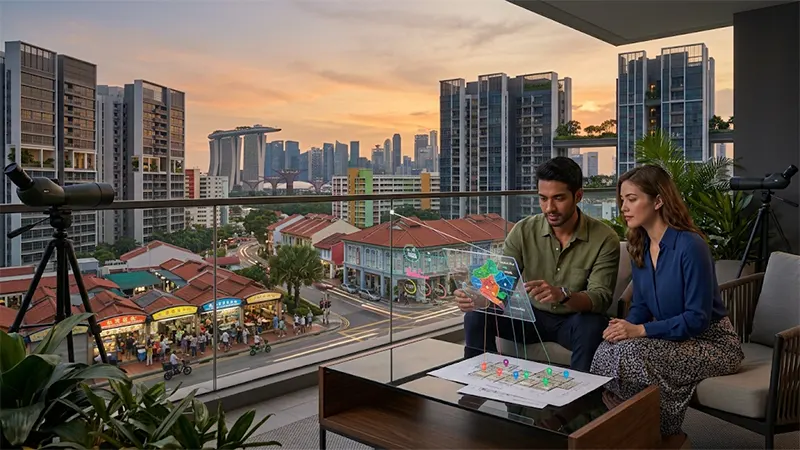
When people search for a new home in Singapore, the property itself often receives most of the attention. Buyers compare floor plans, facilities, layouts, prices and architectural designs before making a decision. Yet one of the most important parts of the home-buying process exists outside the development’s boundaries: the neighbourhood.
A residential address can influence how people commute, shop, spend their weekends, access schools and enjoy leisure time. For this reason, understanding the character of a neighbourhood is an important part of researching Singapore real estate.
Singapore’s urban environment is particularly interesting because residential communities are often closely connected to public transport, commercial centres, parks, schools and other facilities. This creates opportunities for residents to organise many aspects of daily life within a relatively compact area.
What Makes a Neighbourhood Suitable for Residential Living?
There is no universal formula for choosing the right neighbourhood. Different households have different priorities.
A young professional may prefer quick access to business districts and restaurants, while a family may place greater importance on schools, supermarkets and parks. Retirees may prefer quieter surroundings with convenient access to healthcare and public transport.
The first step is therefore to understand personal requirements.
Instead of asking whether a neighbourhood is generally good, buyers can ask whether it is suitable for their own routine. This creates a much more useful way of comparing residential locations.
For example, someone who travels by MRT every day should investigate railway connections and walking routes. A household with young children may need to research schools and childcare facilities. Someone who enjoys outdoor activities may place greater importance on parks, walking paths or waterfront areas.
The Growing Importance of Walkability
Walkability has become an increasingly relevant consideration in urban residential planning.
A neighbourhood can be convenient when residents can walk to everyday destinations instead of depending on a car for every journey. Supermarkets, cafés, restaurants, public transport and recreational spaces within reasonable walking distance can make daily routines easier.
Walking also allows residents to experience a neighbourhood differently. Streets, landscaping, public spaces and surrounding buildings can all contribute to the atmosphere of a residential area.
For prospective homeowners, it is useful to physically walk around a neighbourhood before making a decision. Online maps can show distance, but they cannot fully communicate the experience of walking along a particular route.
One Chuan Grove in the Context of Urban Neighbourhoods
One Chuan Grove can be considered from this wider neighbourhood perspective.
Rather than concentrating exclusively on the development itself, prospective buyers can examine the surrounding Chuan Grove and Lorong Chuan area and consider how it fits their lifestyle.
Transport access, schools, shops and daily conveniences are all worth investigating. Families may be particularly interested in nearby educational options, while professionals may want to understand commuting routes.
The surrounding environment can also affect the experience of living in a development. Noise, traffic, pedestrian activity and the relationship between residential buildings and nearby roads are practical details that buyers can better understand through an actual neighbourhood visit.
Public Transport and Everyday Mobility
Singapore’s MRT system plays an important role in residential decision-making. For many households, access to public transport can influence both convenience and lifestyle.
A nearby MRT station can make it easier to reach employment centres, shopping districts, educational institutions and recreational destinations. However, buyers should look beyond the distance displayed on a map.
The actual walking route matters. So do road crossings, sheltered pathways and the time required to reach the station during different parts of the day.
Bus services can also be important. Some destinations may be easier to reach by bus than by MRT, particularly when transfers would otherwise be necessary.
For drivers, the surrounding road network deserves equal attention. Expressways and major arterial roads can influence commuting patterns, especially for households travelling across different parts of Singapore.
Waterfront Areas and Residential Lifestyle
Waterfront locations can create a distinctive relationship between residential developments and the surrounding urban environment.
River Opus is situated in the River Valley area, where the Singapore River forms an important part of the wider neighbourhood setting.
The River Valley district combines residential areas with commercial, dining and recreational destinations. Nearby places such as Robertson Quay and Great World provide residents with additional options for shopping, eating and leisure.
For some homeowners, having these destinations nearby can make the neighbourhood more appealing. Others may prefer a quieter environment with fewer commercial activities.
The important point is that lifestyle preferences should guide the evaluation rather than assumptions about what makes a location attractive.
The Role of Schools in Residential Decisions
For families, education can be one of the most important considerations when selecting a neighbourhood.
Parents may research nearby schools, travel times and available transport options. However, proximity should not be the only consideration. Families should also understand school admission requirements and the relevant policies before treating a particular school as a deciding factor.
A neighbourhood with several educational institutions can provide more options, but individual circumstances will determine which options are realistic and suitable.
Families should also consider how school journeys fit into their daily routines. A school that is geographically close may still require a less convenient route than expected.
Shopping and Dining as Everyday Amenities
Retail and dining options can make a significant difference to residential convenience.
A nearby shopping centre can provide supermarkets, pharmacies, restaurants and other essential services under one roof. Smaller shops and independent food outlets can add variety to a neighbourhood.
However, the ideal balance differs between buyers.
Some people prefer a lively environment with numerous restaurants and cafés. Others may prioritise quieter streets and only require basic amenities within easy reach.
When visiting a prospective neighbourhood, buyers can make a list of the facilities they use regularly and check how easily they can access them.
Parks and Outdoor Spaces
Green spaces can contribute to the quality of a residential environment by providing places for exercise, relaxation and outdoor activities.
Singapore’s planning approach incorporates greenery and recreational spaces into many parts of the city. Parks, park connectors and landscaped areas can give residents opportunities to spend time outdoors without travelling far from home.
For buyers who value an active lifestyle, these spaces can be an important part of the property search.
A simple way to evaluate this is to consider how likely residents are to use the available outdoor areas. A park that is technically nearby but difficult to access may be less useful than a smaller green space that is easy to reach.
How Neighbourhoods Change Over Time
A neighbourhood should not be viewed as completely static.
New residential projects, transport improvements, commercial developments and infrastructure upgrades can gradually change the way an area functions.
This makes future planning an important part of property research. Buyers can review available planning information to understand how an area may evolve.
However, future plans should be treated carefully. Proposed projects can change in timing, scope or implementation, so buyers should distinguish between confirmed developments and early-stage proposals.
The current condition of a neighbourhood should remain an important part of the decision.
Why Buyers Should Visit During Different Times
One of the simplest ways to understand a neighbourhood is to visit it more than once.
A weekday morning can reveal traffic and commuting patterns. An afternoon visit may provide a better sense of schools, shopping and pedestrian activity. An evening visit can show noise levels, dining activity and how the streets feel after working hours.
Weekends can provide another perspective.
Visiting at different times helps buyers build a more complete picture of the environment rather than basing their opinion on a single property viewing.
Comparing Established and Emerging Areas
Singapore offers both mature residential districts and areas undergoing continued development.
Established neighbourhoods may already have extensive amenities, mature transport connections and a recognisable community environment. Emerging areas may offer newer infrastructure and developments but could still be evolving.
Neither type should automatically be considered preferable. The right choice depends on what the buyer values.
People who prioritise convenience may appreciate an established neighbourhood, while others may be interested in newer developments and evolving districts.
A Practical Neighbourhood Evaluation Checklist
Before committing to a property, buyers can consider several questions:
- How long does the daily commute actually take?
- Is public transport convenient?
- Are supermarkets and essential services nearby?
- Are schools accessible for families?
- Are there parks or recreational spaces?
- Does the neighbourhood suit the household’s preferred lifestyle?
- How busy is the area during different times of day?
- Are there major roads or other potential sources of noise nearby?
- What future developments are planned?
- Does the location still make sense if the household’s needs change?
Answering these questions can turn a general property search into a more structured evaluation.
Looking at the Bigger Picture
A residential development is only one part of the environment in which people live. The streets around it, nearby amenities, transport options and wider neighbourhood all contribute to the overall experience.
For buyers researching One Chuan Grove, examining the surrounding neighbourhood can help provide context beyond the development’s own facilities. The Chuan Grove and Lorong Chuan area should be considered according to each household’s transport, education, lifestyle and daily convenience requirements.
For those researching River Opus, the River Valley setting provides another example of how a residential project can be connected to established urban amenities, the Singapore River and nearby lifestyle destinations.
Ultimately, choosing a home in Singapore is not simply about selecting a building. It is about choosing an environment in which everyday life will take place.
A well-researched neighbourhood can help buyers understand whether a property fits their routines today and whether it has the flexibility to support their needs in the future. By considering transport, amenities, schools, recreation and the potential evolution of the surrounding area, prospective homeowners can approach Singapore’s residential market with a more complete perspective.

