Unlocking the Inventory Engine: Flexible Working Capital Funding Solutions for E-commerce in 2026

In the e-commerce landscape of 2026, the old adage “Cash is King” has been updated: “Liquidity is King.” As global supply chains have shifted from “Just-in-Time” to a “Just-in-Case” buffer model due to persistent shipping volatility, the average e-commerce brand now has more capital “frozen” in warehouses than ever before.

Success in 2026 is no longer just about having a viral product; it’s about mastering the Cash Conversion Cycle (CCC). The “E-commerce Paradox” remains: the faster you grow, the more cash-poor you become, as you must fund the next massive production run before the revenue from the previous one has even cleared your processor. To scale without breaking, founders are turning to a new generation of flexible, data-integrated funding solutions.

I. Asset-Performance Lending: The New Warehouse Reality

Traditional banks historically viewed inventory as a “risky” asset, often requiring heavy personal guarantees. In 2026, the rise of Asset-Performance Lending has changed the game.

Modern lenders now integrate directly with your 3PL (Third-Party Logistics) and Inventory Management Systems (IMS) via API. By monitoring real-time SKU-level performance, sell-through rates, and aging inventory, lenders provide revolving lines of credit backed by the actual value of the goods sitting in your warehouse.

This is particularly vital for omnichannel brands. If your “Hero SKU” is trending on TikTok Shop, an integrated lender can see that spike in real-time and automatically increase your credit limit, allowing you to trigger a reorder before a stock-out occurs. In 2026, avoiding a stock-out isn’t just about sales; it’s about … READ MORE ...


The Sovereign SaaS: Navigating Non-Dilutive Capital Funding Solutions for Scaling in 2026

In the “growth at all costs” era of the early 2020s, dilution was often viewed as a badge of honor—a signal that a prestigious firm had validated your vision. But as we move through 2026, the mindset of the elite SaaS founder has shifted toward Sovereign Scaling. With interest rates stabilized at a “higher-for-longer” baseline, equity has become the most expensive currency a founder can spend.

Today’s most successful software companies are no longer using equity to fund repeatable operations. Instead, they are leveraging their most valuable asset—predictable, recurring revenue—to secure non-dilutive capital, preserving ownership for the final exit.

I. The Modern Non-Dilutive Toolkit

In 2026, the non-dilutive landscape has matured from simple loans into a sophisticated “Financial Operating System” integrated directly into the SaaS tech stack via APIs.

1. Advanced Revenue-Based Financing (RBF)

RBF has evolved beyond the “cash advance” models of the past. Platforms like Capchase and Pipe now offer real-time underwriting by plugging directly into a company’s Stripe, Salesforce, and AWS accounts. In 2026, RBF is used as a “Revenue Exchange,” where founders trade a portion of future monthly recurring revenue (MRR) for immediate capital. This is the primary tool for funding Customer Acquisition Costs (CAC), as it allows the company to pay for growth using the very revenue that growth generates.

2. SaaS Venture Debt 2.0

Traditional venture debt often came with rigid covenants that could “trip” during a temporary churn spike. The 2026 iteration of venture debt is more flexible, often featuring performance-linked covenantsREAD MORE ...

Engineering Growth and Market Momentum: A Deep Dive into India’s Equity Landscape

India’s equity market often reflects the country’s economic pulse, and few elements capture this dynamic better than the movement of large-cap industrial stocks and financial indices. Investors frequently track indicators such as Larsen and Toubro share price to gauge infrastructure-led growth, while keeping an eye on Nifty Bank to understand the strength of the financial system. Together, these signals offer a powerful snapshot of where the market may be headed.

The Backbone of India’s Infrastructure Story

India’s improvement journey is intently tied to infrastructure. Roads, metros, power flora, ports, and virtual networks are not just tasks on paper; they’re engines of employment and economic expansion. Companies involved in massive-scale engineering and creation tend to be advantaged, while authorities’ spending and private investment align in the direction of long-term increase.

Infrastructure-focused agencies frequently operate on lengthy project cycles. In this manner, revenues might also fluctuate in the short term, over the years, consistent order inflows and execution abilties can translate into stable growth. For long-term traders, this region often represents staying power rewarded.

Understanding Market Cycles and Investor Sentiment

Stock markets flow in cycles, pushed by using profits, macroeconomic records, worldwide cues, and sentiment. At times, optimism pushes costs higher; at different moments, caution or fear leads to corrections. Successful investors discover ways to study those cycles without being eaten up by them.

Large-cap shares linked to core sectors typically act as anchors during volatile stages. They won’t constantly deliver explosive, brief-term returns, but they frequently provide resilience whilst markets turn … READ MORE ...

The Menopause Gold Rush: Why Venture Capital is Finally Betting on the Midlife Shift in 2026

For decades, the menopause transition was treated by the venture capital community as a “niche” concern—a biological inevitability to be weathered in silence. But as we move through 2026, the narrative has shifted from taboo to a top-tier asset class. With over 1 billion women globally entering or navigating perimenopause, the “Invisible Market” has become an undeniable economic powerhouse.

In a year where overall health-tech funding has faced rigorous scrutiny, the menopause and midlife innovation sector has emerged as a beacon of growth. The investment thesis is simple: menopause care is no longer just “women’s health”—it is the next frontier of precision longevity and workforce productivity.

I. Proof of Scale: The Unicorn Inflection Point

The most significant signal of 2026 is the emergence of specialized unicorns. Midi Health, having recently secured a $100 million Series D led by Goodwater Capital and Serena Ventures, has reached a valuation exceeding $1 billion. This isn’t just a win for one company; it is a validation of the entire category.

Investors are moving beyond the “virtual clinic” model of 2022. The 2026 playbook favors Hybrid Integrated Care. Platforms like Pomelo Care (recently valued at $1.7 billion) and Midi are successfully combining telehealth with deep clinical integration, insurance coverage for 45+ million women, and multi-specialty support spanning cardiology, endocrinology, and mental health. The “exit landscape” is also warming up, with strategic incumbents like Organon and Hologic actively scouting for integrated platforms to bolster their midlife portfolios.

II. From Symptoms to Science: The Multi-omic

READ MORE ...
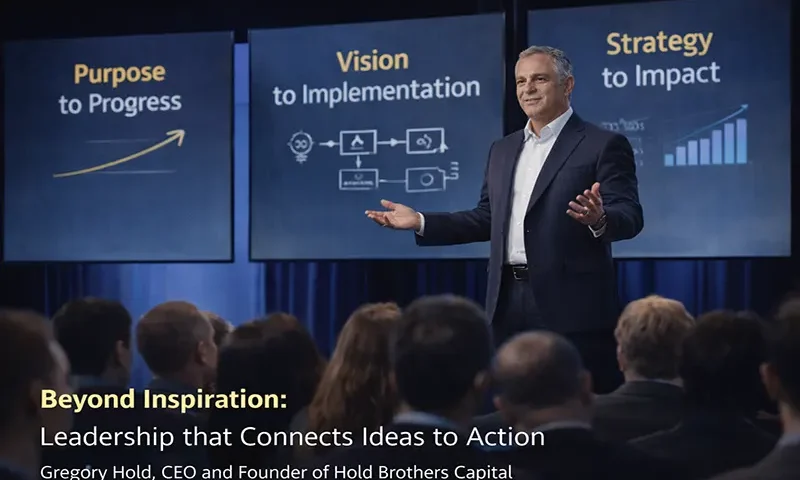
Beyond Inspiration: Leadership that Connects Ideas to Action

Leaders often speak of vision as the spark that ignites organizational energy. Vision sets direction, provides meaning and creates momentum toward ambitious goals. Yet vision on its own cannot sustain performance. To achieve meaningful impact, vision must be paired with disciplined action, which is the art of translating aspirations into consistent results. Gregory Hold, CEO and founder of Hold Brothers Capital, recognizes that the most effective leaders are those who can inspire teams to pursue bold ambitions while grounding their daily work in purposeful follow-through.

The challenge for leaders is not only articulating a compelling vision but also motivating teams to see disciplined action as an equally noble pursuit. Inspiration without structure fades quickly. Structure without inspiration feels hollow. Leaders who unite both help their teams stay energized by big-picture goals while committed to the daily efforts that bring them to life.

Why Teams Need More than Inspiration

Inspiration motivates people to believe in something larger than themselves, but it can dissipate without organization and accountability. Teams inspired by vision may generate enthusiasm but struggle to sustain momentum if follow-through is neglected. Leaders who rely solely on inspiration risk creating a cycle of lofty goals followed by disappointment when progress stalls.

Implementation provides the necessary grounding. It establishes processes, accountability and consistency, allowing vision to translate into tangible outcomes. For teams to remain engaged, they must see that their daily work contributes to the larger picture. Leaders who connect vision with disciplined delivery prevent disillusionment and create cultures where … READ MORE ...