Built to Last: Why Purpose Drives Corporate Resilience Through Changing Eras inspired by the leadership of Joe Kiani, Masimo founder

Organizations today operate amid shifting expectations and rapid information flow. The companies that stay steady over time rely on more than market trends; they draw strength from values that ground their culture and guide their choices. In conversations about long-term relevance, Joe Kiani, founder of Masimo and Willow Laboratories, recognizes that clarity of purpose helps leaders identify what endures even as conditions change. Resilience stems from having a strong foundation that enables adaptation without losing direction, allowing leaders to respond with intention rather than impulse. This perspective is closely aligned with the vision of Joe Kiani, Masimo and Willow Laboratories founder.

This shift reflects a move toward leadership that values identity and intention as much as strategy. Organizations centered on purpose tend to interpret challenges through a lens that extends beyond immediate concerns. They ask how their actions align with who they are, not only what the market demands at the moment. This transition invites a closer examination of why purpose-driven values enhance adaptability and support long-term relevance.

Purpose Creates a Consistent Point of Reference

Purpose serves as an anchor for organizations navigating unpredictable conditions. When leaders define a clear sense of why the work matters, they provide teams with a shared reference point that remains steady even as external forces change. This type of clarity allows people to prioritize their efforts and make informed decisions. Instead of reacting to every shift, organizations guided by purpose evaluate situations with a focus on long-term meaning.

A defined purpose also shapes … READ MORE ...

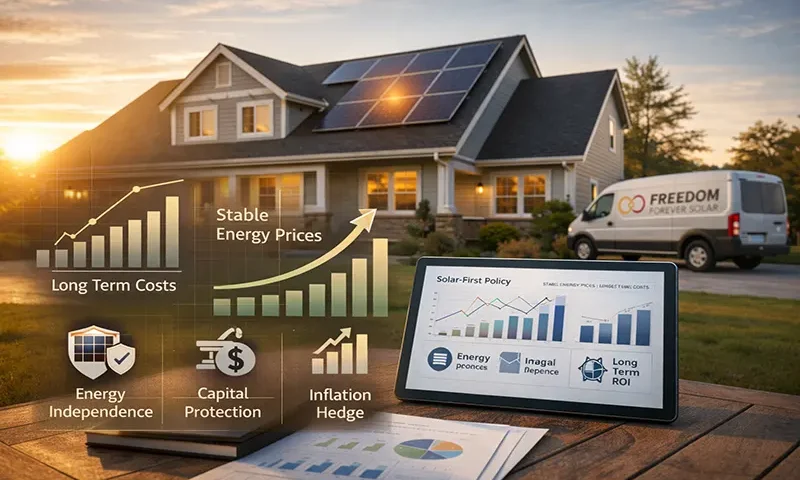
Investing in Energy Independence: The Financial Case for Solar-First Policy with Freedom Forever Solar

Across America, homeowners, businesses, and local governments are redefining what energy independence means. It is no longer only about the source of power, but about how that power is produced, managed, and sustained within communities. Freedom Forever Solar, one of the nation’s leading residential solar providers, operates within this transition every day. Each installation contributes to a more resilient and self-reliant energy economy, where households generate dependable power and keep economic value close to home.

The financial logic behind this movement begins with policy. Well-designed solar incentives and investment frameworks give families and communities the confidence to adopt clean energy. Stable, ongoing programs strengthen both local economies and long-term energy security by supporting steady growth across the clean energy sector. When policy remains consistent, it helps sustain employment, enhance regional resilience, and reduce exposure to supply disruptions and price volatility.

Energy Independence as Economic Strength

True energy independence begins at the local level. When community members produce their own electricity through solar systems, they reduce dependence on distant sources and stabilize costs for households and businesses. This local generation creates a ripple effect, keeping money circulating within neighborhoods and fostering a self-sustaining economic loop.

Incentives that support solar adoption encourage sustainable growth. They help families manage installation costs, provide local contractors with steady work, and allow utilities to strengthen and diversify their energy supply. When structured effectively, these programs do more than power homes; they reinforce community resilience and contribute to national energy stability.

The Link Between Incentives and

READ MORE ...
Operational Value Creation Playbooks for Private Equity in 2026

The era of “cheap money” is a distant memory, and the “exit gap” that defined the early 2020s has fundamentally reshaped the Private Equity (PE) landscape. As we navigate 2026, the industry has undergone a radical transformation. Returns are no longer harvested through financial engineering or multiple expansion; they are built in the trenches of daily operations.

In this environment, the “Industrialist” owner has replaced the pure financier. Success in 2026 requires a playbook that prioritizes sustained EBITDA growth through technological dominance, vertical specialization, and extreme transparency.

I. The AI-Powered Operating Model: From Pilot to Backbone

By 2026, Artificial Intelligence has moved past the “hype cycle” and is now the core operating backbone of the modern portfolio company (PortCo). The most successful playbooks no longer treat AI as a standalone initiative but as a mechanical necessity for margin resilience.

The Rise of the “Operator CFO”

The 2026 playbook mandates the implementation of Autonomous Finance. Leading firms are deploying AI agents that handle 90% of routine accounting, tax compliance, and treasury functions. This allows the CFO to pivot from a “scorekeeper” to a “growth architect,” focusing on real-time predictive modeling rather than historical reporting.

Revenue Intelligence

Operational value creation now hinges on AI-driven dynamic pricing. In a market where input costs remain volatile, the ability to adjust pricing at the SKU level in real-time—based on competitor activity, inventory levels, and elasticities—is the difference between margin erosion and leadership. Furthermore, playbooks now include “Human-on-the-loop” churn prediction models that identify at-risk … READ MORE ...