
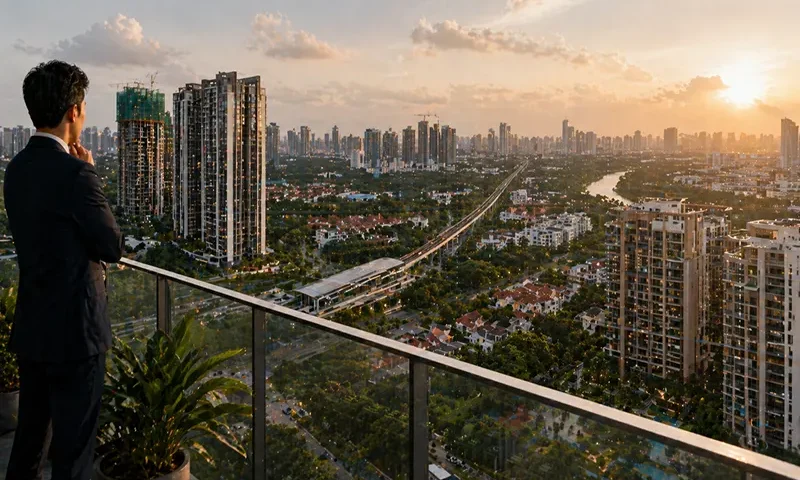
Singapore’s property market does not move in a straight line. It moves in cycles, driven by interest rates, government cooling measures, supply pipelines, and investor sentiment. Understanding where the market sits in the cycle is often more important than picking the “perfect” condo.
As we move into 2026, investors are closely watching how different segments of the market adjust—and how developments like Thomson Reserve and Amberwood at Holland fit into the next phase of positioning.
1. Understanding the Property Cycle in Simple Terms
A typical property cycle has four phases:
- Recovery Phase → Low sentiment, stable prices, cautious buyers
- Growth Phase → Rising demand, increasing transactions
- Peak Phase → Strong prices, high competition, FOMO buying
- Cooling Phase → Slower demand, price stabilization or correction
Most investors lose money not because they pick bad properties, but because they enter at the wrong phase.
2. Where Singapore Stands Heading Into 2026
As of the current cycle, Singapore is generally transitioning between:
- Late stabilization after strong growth periods
- Selective demand recovery in key districts
- More price sensitivity due to interest rates and affordability constraints
This means:
- Not all segments move together
- Some districts still show resilience
- Others experience slower absorption
This is where smart positioning becomes critical.
3. Flight to Quality Assets
In the current cycle, investors are becoming more selective. Instead of chasing all launches, they are focusing on:
- Strong location fundamentals
- Livable long-term environments
- Rental stability
- Proven demand resilience
This “flight to quality” benefits projects like Thomson Reserve, which appeals to long-term residential stability, and Amberwood at Holland, which remains attractive due to lifestyle-driven demand and established connectivity.
4. How Interest Rates Are Reshaping Demand
Interest rates remain one of the strongest forces influencing the 2026 cycle.
Higher borrowing costs lead to:
- More cautious buyers
- Smaller loan approvals
- Slower speculative demand
This creates a market where:
- Genuine long-term buyers dominate
- Short-term flipping becomes less attractive
- Value-based purchasing becomes more important
In this environment:
- Thomson Reserve benefits from stable owner-occupier demand
- Amberwood at Holland attracts buyers who still value location and lifestyle despite higher financing costs
5. The Rise of Selective Growth Zones
Not all districts in Singapore move equally during the same cycle phase.
In 2026, we see:
- Mature lifestyle districts maintaining steady demand
- Residential enclaves offering defensive stability
- New launch areas competing for attention more aggressively
This creates a fragmented market where timing and micro-location matter more than ever.
6. Rental Market as a Cycle Indicator
Rental performance often leads price movements.
Key signals include:
- Rising rental inquiries → early recovery
- Stable occupancy → balanced market
- Increasing vacancies → cooling pressure
In 2026:
- Lifestyle-heavy areas like Amberwood at Holland tend to respond faster to expat and professional demand shifts
- Stable residential areas like Thomson Reserve maintain consistent occupancy even during softer cycles
Rental strength often signals where capital will flow next.
7. Shift from Speculation to Yield Focus
Earlier cycles were driven by capital gains speculation. The 2026 environment is more yield-conscious.
Investors now prioritize:
- Sustainable rental returns
- Lower volatility
- Long-term holding stability
This shift reduces aggressive flipping behavior and increases demand for fundamentally strong assets.
8. Supply Pipeline Pressure and Its Effect
New supply remains one of the biggest cycle influencers.
When supply increases:
- Buyers gain more choices
- Price competition intensifies
- Older launches face slower appreciation
When supply tightens:
- Prices stabilize
- Resale demand strengthens
- Sellers gain pricing power
Both Thomson Reserve and Amberwood at Holland are impacted differently depending on surrounding supply conditions, making location context critical.
9. Psychological Phase of the Market
Market cycles are not just financial—they are psychological.
Current sentiment shows:
- Less FOMO compared to peak cycles
- More research-driven buying decisions
- Greater focus on long-term sustainability
This benefits well-positioned, fundamentally strong developments rather than hype-driven launches.
10. Strategic Positioning for 2026 Investors
Smart investors entering this cycle focus on:
- Avoiding peak-priced emotional buys
- Targeting stable demand zones
- Balancing lifestyle vs residential stability
- Prioritizing long-term holding resilience
In this framework:
- Thomson Reserve represents defensive stability and long-term holding strength
- Amberwood at Holland represents lifestyle-driven demand with strong rental potential in the right cycles
Final Thoughts
The Singapore property market in 2026 is not about chasing rapid gains—it is about selective positioning within a mature, cycle-sensitive environment.
Understanding where the market sits in its cycle helps investors avoid emotional decisions and focus on fundamentals that survive across phases.
Whether it is Thomson Reserve or Amberwood at Holland, success depends less on timing perfection and more on aligning strategy with the correct phase of the cycle.
In real estate, the cycle doesn’t just influence prices—it determines opportunity itself.

