
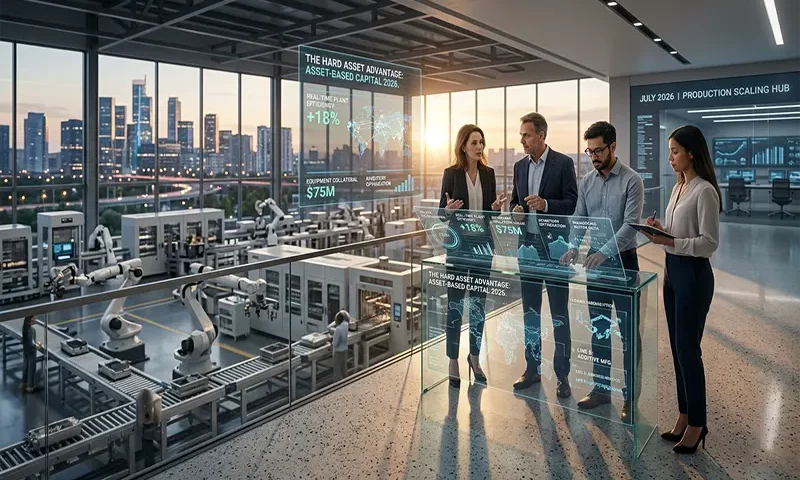
The manufacturing sector in 2026 is defined by a massive “Growth Bottleneck.” As the global reshoring movement hits its stride and domestic production capacity is stretched to its limit, manufacturers are finding themselves in a difficult position: they have the orders, but they lack the liquid capital to fund the facilities, robotics, and raw materials needed to fulfill them.
In this “higher-for-longer” interest rate environment, traditional cash-flow lending—predicated on historical EBITDA ratios—often fails to provide the necessary headroom for rapid scaling. Enter the modern era of Asset-Based Lending (ABL). By shifting the focus from the income statement to the balance sheet, ABL allows manufacturers to unlock the “frozen” value in their machinery, inventory, and invoices, providing the high-octane fuel needed for the factory floor of 2026.
I. The Manufacturing ABL Toolkit: Liquifying the Floor
Unlike traditional loans, ABL is dynamic. As your assets grow, your Borrowing Base expands, providing a self-correcting line of credit that moves at the speed of your production cycle.
1. Equipment Term Loans & “Smart” Leasing
The transition to “Industry 4.0” has been capital-intensive. Manufacturers are replacing legacy hardware with IoT-enabled CNC machines, autonomous mobile robots (AMRs), and industrial 3D printing arrays. In 2026, lenders view this equipment with higher favor. Because “Smart” machinery provides real-time data on uptime and maintenance, it has a more predictable Forced Liquidation Value (FLV), allowing for higher advance rates.
2. Inventory Financing: The New Buffer Strategy
The “Just-in-Time” model of the 2010s is officially dead. Geopolitical shipping volatility has forced manufacturers into a “Just-in-Case” strategy, holding six to nine months of raw materials. ABL providers now offer revolving credit lines against these raw materials (steel, copper, polymers) and finished goods. Crucially, 2026 standards now allow for the inclusion of In-Transit Inventory, providing liquidity while goods are still on the water.
3. Accounts Receivable (AR) Factoring
For manufacturers selling to blue-chip aerospace, automotive, or defense buyers, the “Net-90” payment cycle is a major strain. AR Factoring allows you to convert those unpaid invoices into immediate cash (typically at a 90% advance rate), ensuring that payroll, energy costs, and R&D continue uninterrupted while you wait for the buyer to settle.
II. Industry 4.0 and “Collateral Intelligence”
The biggest technological shift in 2026 ABL is the rise of Collateral Intelligence. Lenders no longer rely solely on annual physical audits; they plug directly into the factory’s Manufacturing Execution System (MES).
By monitoring machine health and output in real-time, lenders can offer Dynamic Borrowing Bases. If a manufacturer lands a massive contract and their machines are running at 95% capacity, the lender can see the increased “Asset Performance” and automatically expand the credit line.
Furthermore, we are seeing the emergence of the “Green Premium.” Manufacturers investing in net-zero energy house-plants or carbon-capture machinery often qualify for “Green ABL” rates. These ESG-linked loans provide a 25-50 basis point discount on the interest spread, rewarding capital efficiency that reduces environmental impact.
III. Strategic Use Cases for Expansion
In 2026, ABL is being used as a surgical tool for structural growth:
- Facility Buyouts: Many mid-market manufacturers are using ABL to move from leasing their plants to owning the real estate. This not only stabilizes long-term costs but adds a massive new asset class (Real Estate) to their borrowing base.
- M&A Bridge Funding: When acquiring a competitor, a manufacturer can use the target company’s own assets—their machinery and inventory—as the collateral to fund the acquisition itself.
- Automation Retrofitting: Rather than diluting equity to fund a $10M robotics upgrade, manufacturers use an Equipment Term Loan to spread the cost over the 7-to-10-year useful life of the robots.
IV. Risk Mitigation: Managing the Borrowing Base
While ABL provides immense flexibility, it requires rigorous discipline. In 2026, the primary risk is Asset Depreciation. If a manufacturer is using a line of credit against equipment that is becoming obsolete, the borrowing base can shrink, leading to a “liquidity squeeze.”
To mitigate this, successful 2026 manufacturers maintain “Liquidity Headroom”—never drawing more than 80% of their available borrowing base. They also utilize 2026-standard third-party appraisals every six months to ensure their collateral valuations remain accurate in a shifting global market.
V. The Sidebar: Supply Chain Finance Integration
Leading manufacturers are now layering ABL with Supply Chain Finance (SCF). While ABL funds the internal expansion, SCF allows the manufacturer’s suppliers to be paid early by a bank based on the manufacturer’s credit rating. This “Double-Sided” liquidity ensures that as the factory expands, the entire supply chain scales with it.
Your Balance Sheet as a Growth Engine
In the industrial landscape of 2026, the winners are those who view their assets not just as tools of production, but as tools of finance. Asset-Based Lending has evolved from a “last resort” for distressed firms into the “first choice” for high-growth manufacturers. By leveraging the hard value of your equipment, inventory, and invoices, you can navigate the capital-intensive demands of the modern era without sacrificing equity. In the new industrial age, your factory floor isn’t just a place where you make things—it’s a place where you make growth possible.

