
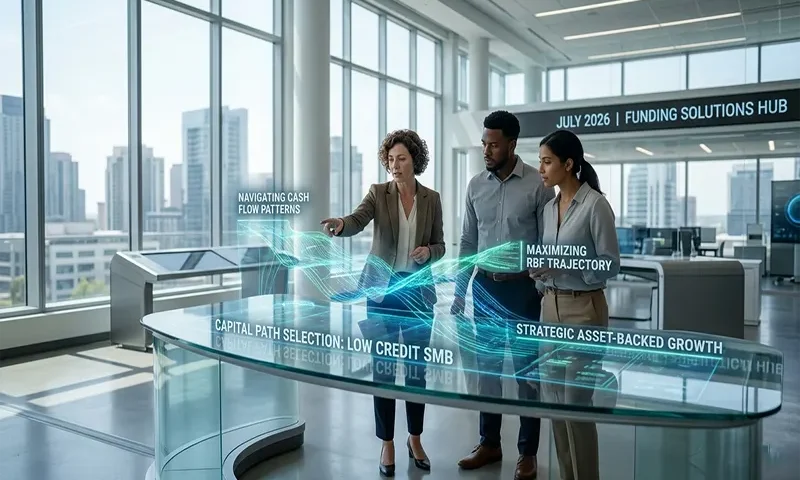
For decades, a small business owner’s personal FICO score was the gatekeeper to growth. If that three-digit number was low—whether due to past medical debt, a failed previous venture, or simply a lack of credit history—the door to traditional banking was firmly bolted.
As we navigate 2026, the paradigm has shifted. We have entered the era of Data-Driven Lending. While traditional banks still lean on legacy scoring, a new ecosystem of “Alternative Capital” has matured. These lenders recognize that a credit score is a lagging indicator of the past, whereas real-time cash flow is a leading indicator of the future. For the small business owner with low credit, the path to capital is no longer blocked; it has simply moved to a different track.
I. Cash Flow as the New Collateral: Revenue-Based Financing
The most significant breakthrough for low-credit owners in 2026 is the refinement of Revenue-Based Financing (RBF) and modernized Merchant Cash Advances (MCA 2.0).
In this model, the lender is not “loaning” you money in the traditional sense; they are purchasing a portion of your future sales at a discount. Because the lender’s repayment is tied directly to your daily or monthly revenue, they care far more about your Sales Velocity than your personal credit history.
The 2026 Transparency Shift
In years past, this sector was plagued by high fees and “debt traps.” However, the 2026 Small Business Truth in Lending Act has mandated clear disclosures. Modern RBF providers now use “Remittance Caps,” ensuring that the amount they pull from your daily sales never exceeds a certain percentage of your income. This protects your operational liquidity, making it a viable tool for scaling inventory or staffing during peak seasons.
II. Leveraging the Asset: Factoring and Lease-Backs
If your credit score is low, the most effective strategy is to “shift the risk” away from yourself and onto an asset.
1. Invoice Factoring
For B2B service providers, your greatest asset is your Accounts Receivable. If you have outstanding invoices from reputable, high-credit clients (like government agencies or large corporations), you can “factor” those invoices. The lender provides you with immediate cash (typically 80–90% of the invoice value) and collects from your client later. The lender’s risk assessment is based on your client’s ability to pay, effectively making your own credit score irrelevant.
2. Equipment Lease-Backs
If your business owns machinery, vehicles, or specialized medical equipment, you can utilize an Equipment Lease-Back. You sell the equipment to a financing company for a lump sum of cash and then immediately lease it back from them. You keep the equipment on-site and operational, while the cash provides the working capital you need. The “collateral” is the equipment itself, providing a safety net for the lender that bypasses your personal credit profile.
III. Community-Centric Capital: CDFIs and Micro-Lenders
In 2026, Community Development Financial Institutions (CDFIs) have become the primary bridge for underserved and low-credit founders. These are mission-driven organizations that receive government backing to stimulate local economies.
Unlike a big-box bank, a CDFI looks at the “Whole Business” case. They prioritize:
- Your business plan and its viability in the local market.
- Your character and industry experience.
- The number of local jobs your business creates or sustains.
While the application process for a CDFI loan is more “high-touch” and takes longer than a digital fintech app, the interest rates are often significantly lower than other alternative options, and they frequently offer free mentorship and credit-building services alongside the capital.
IV. The “Factor Rate” Warning: Calculating the Real Cost
When exploring alternative capital, you will often hear the term “Factor Rate” instead of “Interest Rate.” It is critical to understand the difference. A factor rate is expressed as a decimal (e.g., 1.2). If you borrow $10,000 at a 1.2 factor rate, you will owe a total of $12,000.
The ROI Rule: Only use high-cost alternative capital if the Return on Investment (ROI) is higher than the cost of the funds.
- Example: If borrowing $10,000 at a 1.2 factor rate ($2,000 cost) allows you to buy inventory that will generate $30,000 in revenue, the $2,000 cost is a justifiable expense for a $18,000 profit margin.
V. The “Scale and Repair” Strategy
Using alternative capital in 2026 is not just about survival; it is about rehabilitation. Many modern alternative lenders now report your on-time payments to major business credit bureaus.
Founder’s Checklist for Readiness:
To secure the best alternative terms in 2026, have these items ready in a digital “Data Room”:
- 6 Months of Verified Bank Statements: This is the #1 document alternative lenders use to verify cash flow.
- Point-of-Sale (POS) Integration: Connecting your Square, Clover, or Stripe account allows for instant, automated underwriting.
- A Clean P&L Statement: Even with low credit, showing that your business is operationally profitable (EBITDA positive) makes you a premium candidate for RBF.
Turning the Page on Credit
A low credit score in 2026 is a hurdle, not a dead end. By shifting your focus from “Who am I as a borrower?” to “What is the value of my cash flow and assets?”, you can unlock the capital needed to scale. The landscape of alternative lending has matured into a transparent, data-driven engine that rewards business performance over historical mistakes. In today’s market, your daily sales are your best credit reference—use them wisely.

