
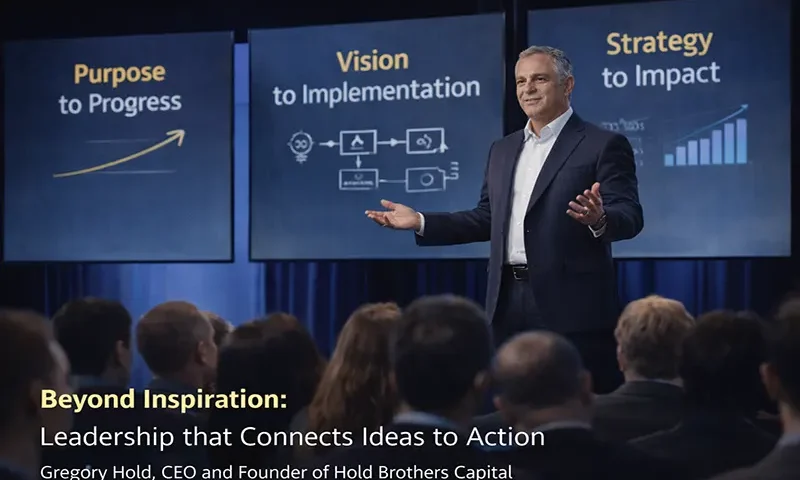
Leaders often speak of vision as the spark that ignites organizational energy. Vision sets direction, provides meaning and creates momentum toward ambitious goals. Yet vision on its own cannot sustain performance. To achieve meaningful impact, vision must be paired with disciplined action, which is the art of translating aspirations into consistent results. Gregory Hold, CEO and founder of Hold Brothers Capital, recognizes that the most effective leaders are those who can inspire teams to pursue bold ambitions while grounding their daily work in purposeful follow-through.
The challenge for leaders is not only articulating a compelling vision but also motivating teams to see disciplined action as an equally noble pursuit. Inspiration without structure fades quickly. Structure without inspiration feels hollow. Leaders who unite both help their teams stay energized by big-picture goals while committed to the daily efforts that bring them to life.
Why Teams Need More than Inspiration
Inspiration motivates people to believe in something larger than themselves, but it can dissipate without organization and accountability. Teams inspired by vision may generate enthusiasm but struggle to sustain momentum if follow-through is neglected. Leaders who rely solely on inspiration risk creating a cycle of lofty goals followed by disappointment when progress stalls.
Implementation provides the necessary grounding. It establishes processes, accountability and consistency, allowing vision to translate into tangible outcomes. For teams to remain engaged, they must see that their daily work contributes to the larger picture. Leaders who connect vision with disciplined delivery prevent disillusionment and create cultures where inspiration fuels commitment rather than replacing it.
Framing Vision as Shared Purpose
One of the most powerful motivational strategies is framing vision not as a top-down directive but as a shared purpose. Leaders who involve employees in shaping the vision create more profound commitment. When teams see themselves reflected in organizational goals, they are more likely to embrace the actions required to achieve them.
Framing vision as shared purpose also builds unity. It shifts focus from individual tasks to collective outcomes, reinforcing that every role contributes to success. Leaders can strengthen this connection through storytelling, transparent communication and recognition of how each person’s work supports the larger mission. This approach makes it meaningful because it becomes a direct expression of shared ambition.
Making Progress Visible and Valued
Implementation often suffers from being seen as routine or uninspiring. Leaders can change this perception by making progress visible and celebrating it as a key driver of success. Dashboards, Milestone celebrations and regular feedback loops remind teams that consistency is not a burden, but the engine of achievement.
Recognition plays a significant role. Celebrating not only the generation of ideas but also the disciplined delivery of those ideas reinforces that both creativity and rigor are valued. Over time, teams internalize the belief that realization is not separate from vision but inseparable from it.
Empowering Teams with Autonomy
Motivation grows when teams feel trusted to carry out their vision in their own way. Leaders who empower teams with autonomy foster both ownership and accountability. Autonomy allows individuals to apply their creativity to implementation, helping responsibility feel empowering rather than restrictive.
Gregory Hold of Hold Brothers Capital highlights that leaders build stronger organizations when they trust teams to balance ambition with follow-through. By granting responsibility and trusting employees to act, leaders encourage a sense of pride in both vision and delivery. This empowerment fuels motivation because employees see themselves not just as implementers of plans but as co-authors of success.
Building a Culture of Alignment
Culture acts as the bridge that connects vision with realization. Leaders who embed alignment into culture keep inspiration and discipline reinforcing each other rather than competing. Clear communication of goals, regular alignment meetings and cross-functional collaboration all strengthen this connection.
A culture of alignment prevents the drift that occurs when teams focus only on their immediate tasks. It reinforces that every action must contribute to a broader vision. Leaders who model alignment themselves inspire teams to replicate this balance in their own work.
Sustaining Motivation Through Resilience
Motivating teams is not only about celebrating success but also about guiding them through setbacks. Disruptions are inevitable, and during such times, leaders must enable both vision and execution to remain intact. Resilient leaders frame challenges as opportunities to reaffirm purpose and refine strategies.
By showing steadiness in adversity, leaders model how to remain focused on progress without losing sight of the bigger picture. This resilience reassures teams, reminding them that setbacks are temporary, but persistence endures. Motivation in such moments comes not from avoiding disruption but from knowing that purpose and disciplined effort remain aligned even under pressure.
The Lasting Impact of Balanced Leadership
The most enduring leaders are those who can keep teams inspired while also grounded. They know that vision attracts attention, but consistent delivery secures results. When teams embrace both, they not only achieve goals but also develop confidence in their ability to meet future challenges.
At Hold Brothers Capital, Gregory Hold illustrates that leadership’s most significant power lies in balancing inspiration with discipline. By cultivating teams that value vision, leaders create organizations capable of sustaining momentum, adapting to change and delivering lasting growth.
Motivational strategies that align vision with implementation do more than achieve short-term targets. They build trust, strengthen culture and position organizations for long-term success. Leaders who inspire teams to embrace both prove that the true measure of leadership is not how brightly vision shines in the moment but how consistently it endures through deliberate action.
What Inspires Endurance
The future of leadership will be defined by those who integrate imagination and discipline, vision and execution, inspiration and follow-through. Teams motivated by this balance become more than employees. They become partners in progress.
By aligning daily work with shared purposes, celebrating tangible progress, empowering autonomy and sustaining resilience, leaders help motivation endure beyond the initial excitement of vision. It deepens because disciplined effort itself becomes inspirational. The leaders who understand this create organizations where ideas live, grow and succeed.

